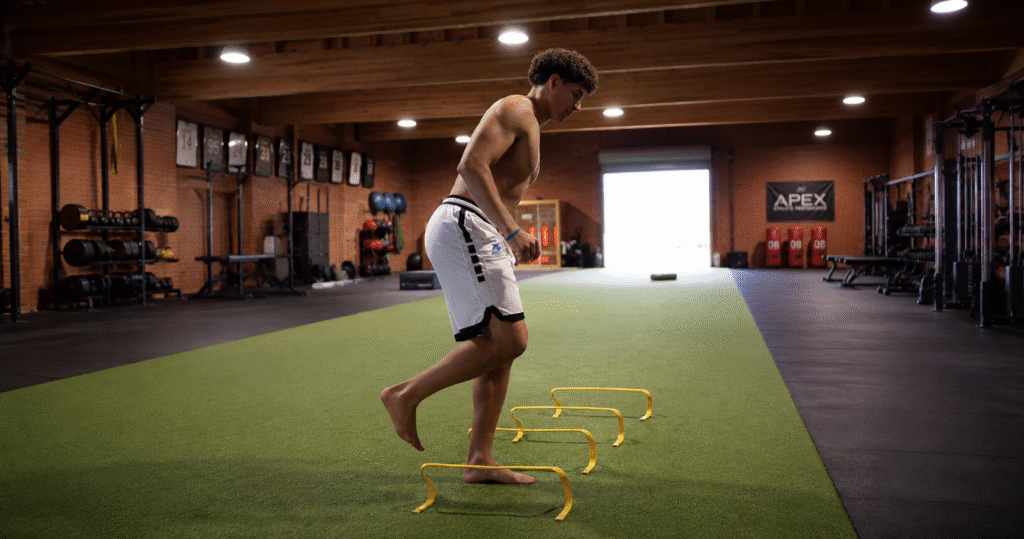
Building Resilient Knees for Basketball
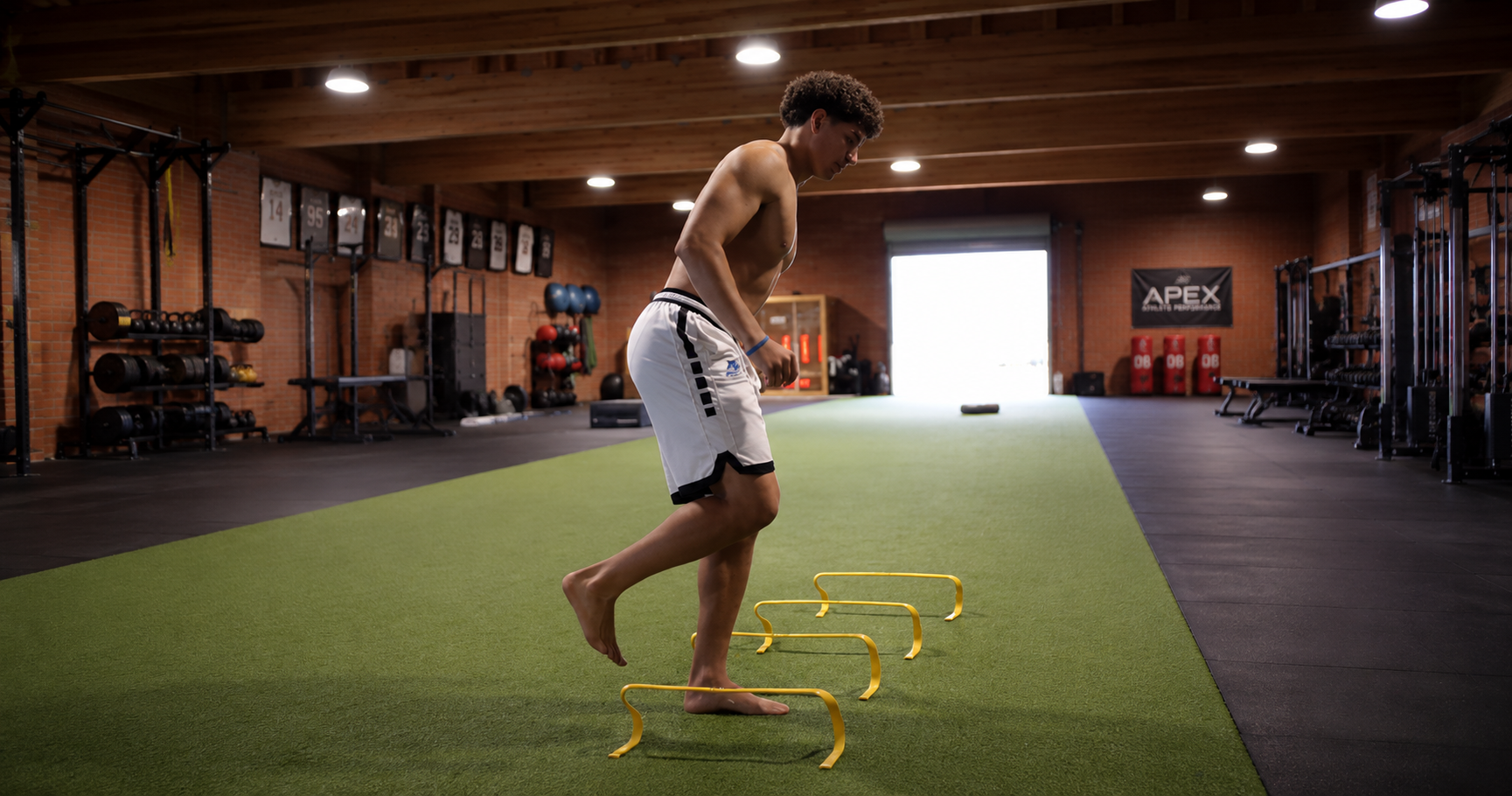
Basketball asks a lot from your knees.
Every game involves hundreds of movements that challenge your body in different ways. Sprinting down the court. Jumping for rebounds. Landing from a layup. Stopping suddenly. Cutting around a defender. Changing direction. Absorbing contact.
Your knees have to handle all of it.
That’s why simply being pain-free isn’t enough for a basketball player.
You need a knee that is strong enough, stable enough, and conditioned enough to handle the demands of the game repeatedly.
At athELITE, we believe knee rehabilitation should focus on building that capacity. The goal isn’t just to get rid of pain. It’s to build a resilient knee that can handle the demands of basketball with confidence.
What Does a Resilient Knee Actually Mean?
A resilient knee isn’t a knee that never experiences stress.
It’s a knee that can handle stress, adapt to it, and recover from it.
Basketball naturally places high demands on the knee. Jumping and landing create significant forces. Sprinting and stopping require your muscles to absorb and produce force quickly. Cutting requires your body to control movement while changing direction.
Your knee needs more than basic strength to handle these demands.
It needs:
- Quadriceps and hamstring strength
- Hip and lower-body strength
- Single-leg control
- Balance and coordination
- Jumping and landing ability
- Deceleration control
- Power and explosiveness
- Adequate conditioning
- Confidence in movement
These qualities don’t develop from simply resting until your knee feels better.
Research on basketball injury prevention supports this approach. Programs that combine strength, stabilization, mobility, agility, and neuromuscular training have been shown to help reduce injury risk in basketball athletes.
They are developed through progressive rehabilitation.
Pain-Free Doesn’t Always Mean Basketball-Ready
One of the biggest mistakes athletes make is assuming that being pain-free means they’re ready to return to the court.
Imagine an athlete recovering from knee pain.
They can walk without symptoms.
They can climb stairs.
They can perform a few bodyweight squats.
Everything feels good.
So they decide they’re ready to play basketball again.
The first game goes well.
Then they start jumping repeatedly, sprinting, stopping, and changing direction.
Suddenly, the knee doesn’t feel so good.
The problem wasn’t necessarily that the athlete was “injured again.”
The problem may be that their knee simply wasn’t prepared for the amount of load basketball demands.
Rehabilitation needs to bridge the gap between normal daily activities and actual basketball performance.
That’s where performance-focused rehab becomes important.
Strength Is the Foundation
Strong muscles help protect and support your knee by allowing you to produce and absorb force effectively.
For basketball players, this means developing strength in more than just the quadriceps.
Your hamstrings, glutes, calves, and other muscles throughout the lower body all contribute to how you move and control your knee.
Single-leg strength is especially important.
Basketball is rarely played with both feet perfectly positioned underneath you. Players constantly jump, land, sprint, and change direction from one leg.
That’s why exercises such as single-leg squats, split squats, step-downs, lunges, and progressive resistance exercises can play an important role in developing the strength required for basketball.
But strength is only the beginning.
A basketball player doesn’t just need to be strong.
They need to use that strength quickly.
Your Knee Needs to Learn How to Absorb Force
Think about landing after a rebound.
Your body has to absorb the force of your landing and control the position of your hip, knee, and ankle.
Now imagine doing that repeatedly throughout a game.
This is why landing mechanics and deceleration are such important parts of basketball rehabilitation.
This is particularly important in basketball, where repeated jumping, landing, and rapid changes in direction place substantial demands on the lower extremity. In youth basketball players, neuromuscular training has been associated with a lower rate of knee and ankle injuries.
Athletes need to learn how to:
- Absorb force efficiently
- Control their knee position
- Maintain balance
- Decelerate safely
- Reproduce good movement under fatigue
These skills should be progressively trained rather than introduced only at the end of rehabilitation.
The goal is to gradually expose the knee to the movements and forces it will eventually need to tolerate on the court.
Resilience Comes From Progressive Loading
Your knee doesn’t become resilient by avoiding stress forever.
It becomes resilient by gradually learning to handle more.
This is the principle behind progressive loading.
You start with a level of exercise your body can tolerate.
Then, as you adapt, the challenge increases.
That could mean:
More resistance.
More repetitions.
More speed.
More range of motion.
More complex movements.
More explosive movements.
Eventually, more basketball-specific demands.
This progression should be individualized.
An exercise that is appropriate for one athlete may be too easy or too difficult for another.
That’s why rehabilitation shouldn’t be a generic list of exercises that every basketball player completes regardless of their injury, strength, or goals.
Basketball Rehabilitation Should Look Like Basketball
Eventually, rehabilitation needs to resemble the activity you’re preparing to return to.
If your goal is basketball, your rehabilitation shouldn’t stop at basic strength exercises.
You eventually need to train the qualities basketball requires.
That may include:
Jumping and landing – Learning to produce and absorb force repeatedly.
Deceleration – Training your ability to slow down under control.
Change of direction – Progressively exposing the knee to cutting and lateral movements.
Acceleration – Preparing the lower body to produce force quickly.
Reactive movement – Adding more unpredictable and sport-specific demands as appropriate.
Fatigue – Preparing the body to maintain movement quality when you’re tired.
The goal is not to make every rehabilitation session look like a basketball practice.
The goal is to gradually close the gap between rehabilitation and the demands of competition.
Research also supports incorporating plyometric and neuromuscular training into injury prevention programs. These types of exercises help athletes develop the ability to produce and absorb force, which is particularly relevant to sports involving repeated jumping and landing.
Don’t Ignore Confidence
There’s another part of knee resilience that doesn’t show up on a strength test.
Confidence.
An athlete can have good strength and still hesitate when landing from a jump.
They can have good mobility but avoid cutting because they’re afraid of their knee giving way.
They can be physically capable of returning but mentally feel like something isn’t right.
That hesitation matters.
Confidence is developed through exposure.
When athletes repeatedly perform challenging movements successfully, their confidence can begin to return.
That’s why progressive rehabilitation isn’t only about preparing the tissues and muscles.
It’s also about preparing the athlete.
How athELITE Builds Resilient Knees
At athELITE, our goal isn’t simply to help basketball players get out of pain.
We want to help them build a knee that is prepared for the demands of the game.
That starts with understanding where the athlete is now and where they need to go.
Your rehabilitation program is individualized around your current strength, symptoms, movement abilities, goals, and basketball demands.
As you improve, your program changes with you.
We progressively build strength, movement control, power, and sport-specific capacity rather than keeping you stuck performing the same basic exercises.
Regular check-in calls with your physical therapist also give you an opportunity to discuss your progress, ask questions, and make adjustments when necessary.
Most importantly, we provide accountability.
Because knowing what exercises to perform is only part of rehabilitation.
Actually completing them consistently is what allows your body to adapt.
For athletes returning from significant injuries such as ACL reconstruction, we can also incorporate objective testing to help evaluate strength, movement, and performance before returning to competition.
Build the Knee Before You Need It
The best time to think about knee resilience isn’t after your next injury.
It’s before it happens.
Basketball will always involve jumping, landing, sprinting, cutting, and stopping.
You can’t eliminate every risk associated with playing the sport.
But you can prepare your body to handle its demands.
That’s what resilience is about.
Not avoiding movement.
Not avoiding load.
Not relying on temporary pain relief.
Instead, it’s about gradually building the strength, control, capacity, and confidence needed to perform.
Final Thoughts
A basketball player’s knee needs to do more than simply feel good.
It needs to perform.
It needs to absorb force.
It needs to produce force.
It needs to control movement.
It needs to tolerate repeated stress.
And it needs to do all of that when you’re tired, moving quickly, and competing against another athlete.
That’s why effective knee rehabilitation should go beyond symptom relief.
At athELITE, we believe athletes deserve a rehabilitation process that prepares them for what comes next. Through individualized programming, progressive exercise, coaching, accountability, and performance-focused testing, we help athletes build stronger and more resilient knees so they can return to the game with confidence.
Because the goal isn’t just to get back on the court.
It’s to build a knee that’s ready to stay there.