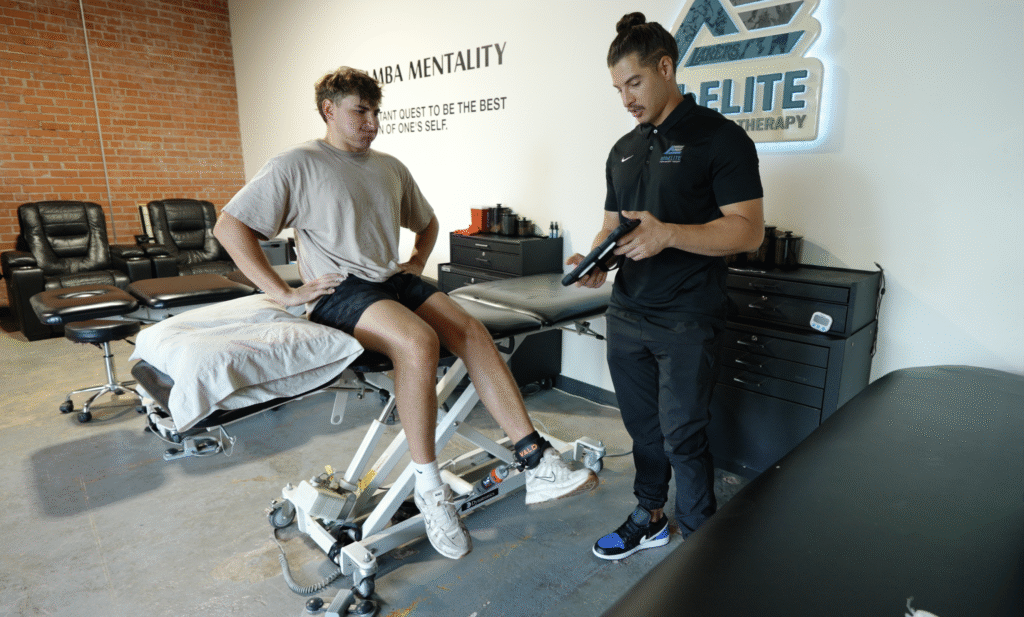
Jumper’s Knee Rehab for Basketball Athletes
Basketball places tremendous stress on the knees.
Every jump, sprint, landing, and change of direction creates force that the body must absorb and control. Over time, those repeated demands can begin to irritate the patellar tendon, leading to one of the most common injuries seen in basketball players: jumper’s knee.
If you’ve ever felt pain just below your kneecap during jumps, squats, running, or basketball activities, you’re not alone.
Many athletes try to push through the pain, hoping it will eventually disappear on its own. Others take time off, rest for a few weeks, and expect the problem to resolve.
Unfortunately, jumper’s knee rarely works that way.
Patellar tendon pain can become frustratingly persistent when the underlying causes are not properly addressed. For basketball athletes, successful recovery requires more than simply reducing pain. It requires rebuilding the tendon, restoring lower body strength, improving movement quality, and preparing the athlete for the demands of basketball.
That is where a proper jumper’s knee rehab program becomes critical.
What Is Jumper’s Knee?
Jumper’s knee, also known as patellar tendinopathy, is an overuse injury involving the patellar tendon. The patellar tendon connects the kneecap to the shinbone and plays a major role in force production during jumping, landing, sprinting, and deceleration.
Basketball athletes place significant stress on this tendon because of the repetitive jumping and explosive movements required throughout practices and games.
Over time, the tendon can become irritated when the amount of stress placed on it exceeds its ability to recover and adapt.
Research published in the British Journal of Sports Medicine has consistently identified jumping sports such as basketball and volleyball as having some of the highest rates of patellar tendinopathy among athletes.
Unlike a muscle strain or ankle sprain, tendon pain often develops gradually. Many athletes notice mild discomfort at first, only to find that the pain slowly worsens over weeks or months.
Why Rest Alone Usually Doesn’t Work
One of the biggest misconceptions about jumper’s knee is that complete rest will solve the problem.
While temporarily reducing activity may calm symptoms, rest alone rarely addresses the underlying issue.
The patellar tendon responds positively to appropriate loading. In fact, research on tendon loading and rehabilitation for patellar tendinopathy suggests that progressive strengthening is one of the most effective approaches for improving tendon health and reducing symptoms.
This is why many athletes experience a frustrating cycle.
The pain improves after taking time off. They return to basketball. The pain quickly returns. Nothing about the tendon’s capacity changed during that period.
Current clinical research on patellar tendinopathy suggests that successful rehabilitation typically involves carefully managing load rather than eliminating it completely. Tendons adapt to stress over time, which is why progressive loading programs are often a key component of long-term recovery.
The athlete simply removed stress temporarily before returning to the same demands.
Successful rehab focuses on gradually improving the tendon’s ability to tolerate basketball activities rather than avoiding loading altogether.
Why Basketball Players Are Especially Vulnerable
Not every athlete develops jumper’s knee.
Basketball players, however, face unique challenges.
The sport demands frequent explosive jumps, rapid decelerations, aggressive changes of direction, and repeated landings throughout games and practices.
Each of these movements places stress on the patellar tendon.
When training volume increases too quickly, recovery is inadequate, or strength deficits exist, the tendon may begin to struggle with these demands.
Research examining risk factors for patellar tendinopathy in jumping athletes has found associations between tendon pain and factors such as training load, jumping volume, lower body strength deficits, and movement mechanics.
This does not mean basketball causes tendon pain.
It means basketball athletes must be prepared for the physical demands their sport places on the body.
The Goal of Rehab Is Not Just Pain Relief
One of the biggest mistakes athletes make is treating pain reduction as the finish line.
Pain matters.
But pain is only part of the recovery process.
Many athletes successfully reduce symptoms but continue to demonstrate deficits that contributed to the problem in the first place.
These deficits may include:
- Quadriceps weakness
- Poor force absorption
- Landing mechanics issues
- Hip and lower body strength deficits
- Limited tolerance to jumping and sprinting
If those problems are not addressed, symptoms often return once basketball activities increase again.
Effective rehab should focus on building capacity, not simply reducing discomfort.
Strength Is One of the Most Important Pieces of Recovery
Research consistently supports progressive strength training as a cornerstone of patellar tendon rehabilitation.
The reason is simple.
The patellar tendon experiences enormous forces during basketball activities. To tolerate those forces, the surrounding muscles and tissues must be capable of handling high loads.
A properly designed rehab program often includes progressive loading strategies that challenge both the tendon and the muscles supporting the knee.
Research on exercise based treatment for patellar tendinopathy has shown that structured strengthening programs can improve both pain and function in athletes with jumper’s knee.
However, strength alone is not enough.
This is where many rehab programs fall short.
Basketball Requires More Than Strength
A basketball game does not happen in a controlled environment.
Athletes react to defenders. They jump unexpectedly. They land in awkward positions. They sprint, stop, and change direction repeatedly. Because of this, rehab should eventually progress beyond strengthening exercises.
Athletes need to rebuild the ability to tolerate basketball specific demands.
This includes:
- Jumping mechanics
- Landing mechanics
- Deceleration control
- Change of direction ability
- Reactive movement
- Basketball specific conditioning
This is one reason why sport specific rehab is such an important part of the recovery process.
Why Return to Sport Matters in Tendon Rehab
Many athletes associate return to sport testing with ACL rehabilitation.
In reality, return to sport principles are important for many injuries, including jumper’s knee.
The question is not simply whether pain has improved.
The question is whether the athlete can safely handle the demands of competition.
Research continues to support the use of objective measures when evaluating readiness for athletic participation.
Athletes recovering from patellar tendon pain should demonstrate appropriate strength, movement quality, power production, and sport specific capacity before returning to unrestricted basketball activities.
This is where return to sport testing technology can provide valuable information throughout the recovery process.
The Mental Side of Jumper’s Knee
Long lasting tendon pain can affect more than physical performance.
Many athletes become frustrated when symptoms linger despite their efforts.
Some begin avoiding movements that previously felt natural. Others lose confidence in their ability to jump, sprint, or perform at their previous level.
While jumper’s knee differs from injuries like ACL reconstruction, confidence still plays an important role in recovery.
Athletes who understand the rehabilitation process and gradually rebuild tolerance to basketball activities often feel more prepared when returning to competition.
Successful rehab addresses both physical and psychological readiness.
What Successful Jumper’s Knee Rehab Looks Like
Successful rehab is not about finding a magic exercise.
It is about following a structured progression that addresses the factors contributing to tendon pain while preparing the athlete for the demands of basketball.
A comprehensive rehab program should focus on:
- Progressive tendon loading
- Lower body strength development
- Force absorption capacity
- Jump and landing mechanics
- Basketball specific conditioning
- Return to sport preparation
The ultimate goal is not simply to reduce symptoms.
The goal is to help athletes return to basketball feeling strong, confident, and prepared to perform.
Final Thoughts
Jumper’s knee is one of the most common injuries affecting basketball athletes, but it is also one of the most misunderstood.
Many athletes spend months chasing temporary solutions without addressing the factors that contribute to tendon pain in the first place.
Successful recovery requires more than rest. It requires a structured approach that builds tendon capacity, improves strength, restores movement quality, and prepares athletes for the demands of basketball.
At athELITE, we combine athlete focused rehabilitation, performance training, and advanced return to sport technology to help athletes recover from knee pain and return to sport with confidence.
If you’re dealing with jumper’s knee and want a rehab process designed around the demands of basketball, the right plan can make the difference between temporary symptom relief and long term success.